Explore how engineering and operations teams integrate cloud AI platforms into daily workflows to eliminate bottlenecks and scale measurable output.
Most organizations have already experimented with generative AI through individual browser chat tabs. Yet individual experimentation rarely translates into company-wide velocity. Copying text back and forth between documents, ticketing systems, and chat windows introduces friction rather than removing it.
True productivity gains happen when teams move from isolated prompting to cloud-native AI workflows—connecting managed foundation models directly to the cloud storage, code repositories, and operational pipelines where work already lives.
The highest-performing teams do not ask employees to write better prompts every morning. They embed cloud AI directly into existing triggers, reviews, and reporting loops.
01. Architecting Cloud AI Pipelines Instead of Isolated Prompts
Cloud AI platforms such as AWS Bedrock, Google Cloud Vertex AI, and Azure AI Foundry allow organizations to treat intelligence as an elastic API layer rather than a standalone destination. Instead of relying on manual copy-paste habits, teams build repeatable three-stage pipelines:
- Context Ingestion: Automatically index approved documentation, incident postmortems, architecture specs, and customer tickets in a managed vector store.
- Reasoning & Synthesis: Route tasks to the right cloud model tier—fast, low-cost models for classification and summarization; deeper reasoning models for architectural synthesis or code analysis.
- Structured Action: Output formatted artifacts directly into pull requests, sprint boards, CRM records, or executive dashboards with human sign-off.
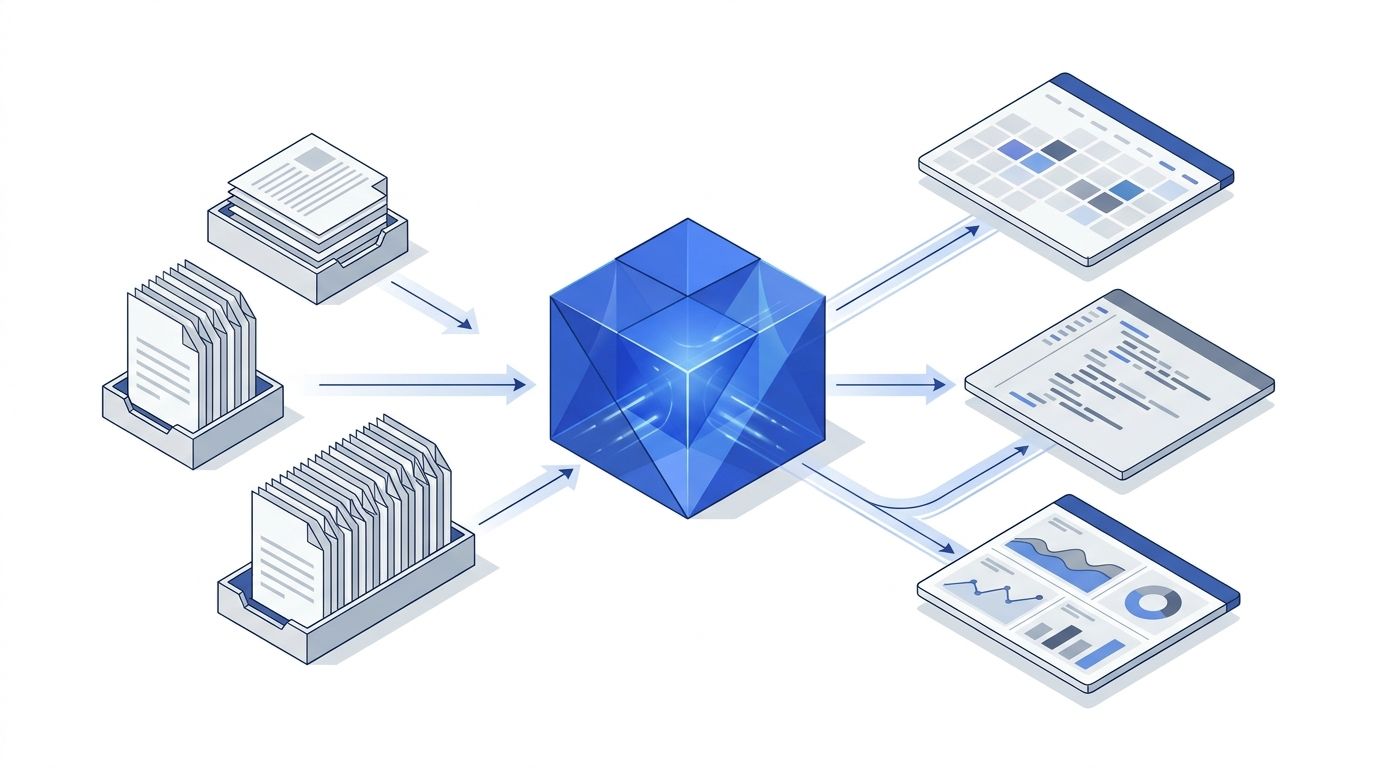
Three-stage cloud AI productivity pipeline connecting document inputs through an AI reasoning hub into schedules, code, and analytics]
By decoupling context retrieval from manual user input, every team member starts from institutional knowledge rather than a blank screen.
02. Four High-Leverage Cloud AI Workflows Across Teams
Rather than rolling out generic AI licenses across every department at once, focus on workflows where unstructured information creates measurable delays.
Software Engineering & Pull Request Triage
Engineering teams lose hours each week to context switching during code reviews, test generation, and incident triage. Cloud-hosted coding assistants and CI-integrated reviewers can automatically summarize pull request diffs, flag missing edge-case unit tests, and correlate production log anomalies against recent deployments.
Knowledge Retrieval & Proposal Drafting (RAG)
Consulting, sales engineering, and compliance teams frequently rebuild answers that already exist across hundreds of past RFPs, security questionnaires, and internal runbooks. Using Retrieval-Augmented Generation (RAG) hosted in your private cloud tenant lets teams generate grounded first drafts complete with citations to source documents.

[Two software engineers reviewing cloud architecture and automation metrics on a studio workstation display]
Project Management & Asynchronous Synthesis
Distributed teams generate massive volumes of meeting transcripts, Slack threads, and sprint updates. Cloud AI workflow connectors can convert raw project check-ins into structured risk logs, dependency updates, and stakeholder summaries—cutting status-meeting overhead while keeping Jira or Linear boards accurate.
Self-Serve Data Analytics & Narrative Reporting
Non-technical operators often wait days for data engineering teams to write one-off SQL queries. Managed natural-language-to-SQL layers running atop cloud data warehouses allow product and operations leads to query governed semantic schemas safely and receive verified charts alongside plain-language variance explanations.
03. Measuring Real Productivity Gains
Adoption metrics like "daily active chat users" reveal very little about business impact. Track operational throughput and cycle-time compression before and after deploying cloud AI workflows:
| Workflow Area | Legacy Manual Baseline | Cloud AI-Assisted Workflow | Primary Outcome |
|---|---|---|---|
| PR Review & Diff Summary | 45–60 min per large PR | 12–18 min with automated context brief | Faster merge cadence |
| Security & RFP Questionnaires | 3–5 business days | 4–6 hours with cited RAG drafts | Higher bid capacity |
| Incident Root-Cause Triage | 50+ min log correlation | Under 10 min log-to-commit clustering | Lower MTTR |
| Weekly Executive Reporting | 4 hours manual assembly | 25 min review of automated synthesis | Reclaimed leadership focus |
Notice that none of these workflows remove human judgment. Cloud AI compresses the mechanical preparation phase—drafting, clustering, summarizing, and cross-referencing—so specialists spend their energy on final decisions.
04. Enterprise Security, Cost Control, and Governance
Scaling cloud AI across production teams requires architectural guardrails from day one. Public consumer endpoints are rarely appropriate for proprietary source code, customer PII, or financial forecasts.
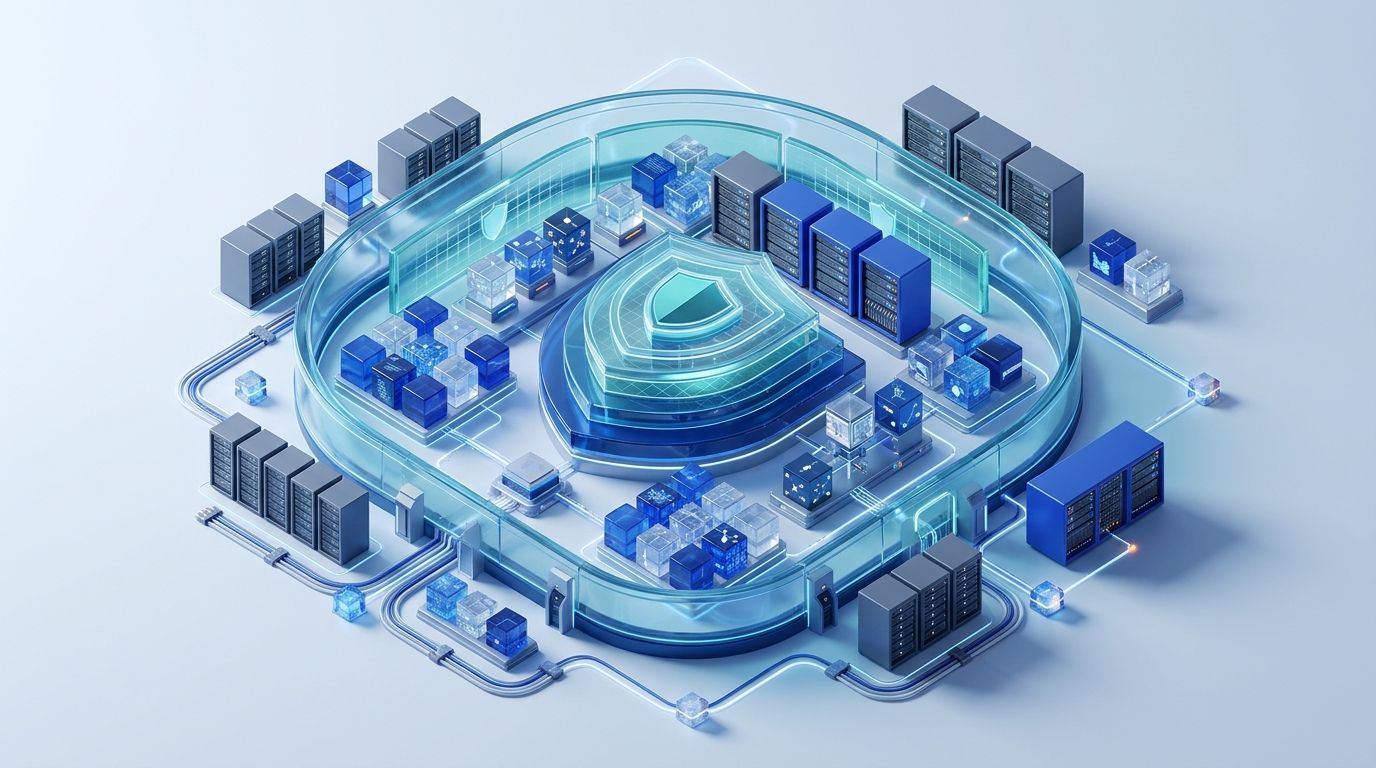
[Isometric diagram of layered cloud security shields protecting distributed enterprise AI data stores]
Implement four non-negotiable standards before moving pilots to production:
- Zero-Data-Retention & VPC Isolation: Ensure model inference runs inside private cloud endpoints where prompts and outputs are never logged for third-party model training.
- Role-Based Context Filtering: Enforce document-level permissions inside your RAG index so employees can only retrieve insights from files they are already authorized to view.
- Model Tiering & Token Budgets: Route high-volume classification and extraction tasks to lightweight models, reserving flagship reasoning models for complex synthesis to keep unit economics predictable.
- Human-in-the-Loop Checkpoints: Require explicit human approval before any AI-generated output merges code, modifies production infrastructure, or sends external client communications.
05. A 30-Day Rollout Checklist for Cloud Teams
If you are ready to operationalize cloud AI without disrupting delivery, execute a focused four-week sprint:
- Week 1 — Audit Friction Points: Interview engineering, ops, and project leads to identify the top three repetitive text-heavy bottlenecks consuming >5 hours per week.
- Week 2 — Connect Governed Data: Stand up a private cloud AI endpoint with IAM-scoped access to one clean knowledge repository (such as Confluence, GitHub docs, or SharePoint).
- Week 3 — Ship One Embedded Workflow: Integrate AI directly into an existing tool—such as a GitHub Action PR summarizer or a Slack-to-Linear triage bot—rather than launching a separate portal.
- Week 4 — Benchmark & Expand: Compare cycle-time metrics against Week 1 baselines, tune prompts and retrieval chunking, and document repeatable templates for the next department.
Ready to modernize your AI data architecture? Datatoinsights.ai helps engineering and enterprise teams design secure, cost-efficient cloud AI pipelines tailored to real operational workflows. Reach out to our cloud specialists to map your first production deployment.